

The Unseen Enemy:
How Water Affects Your Kitchen Knives
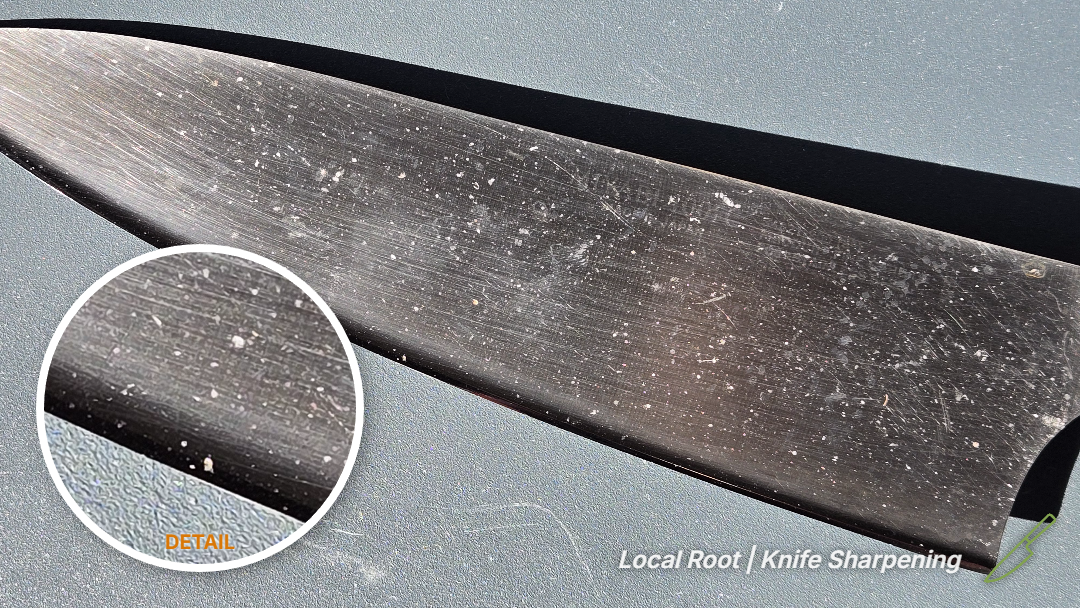
An example of severe pitting on a knife recently brought to Local Root. While the pitting on the face of the blade is permanent, we were able to grind past the corrosion at the very bottom to establish a sharp, clean cutting edge.
It’s a scenario many home cooks encounter: reaching for a favorite kitchen knife only to find its once-pristine surface marred by small pits, dark spots, or a cloudy film. This isn't just cosmetic; it's a tell-tale sign of moisture damage, a silent adversary that slowly eats away at your steel.
It’s a scenario many home cooks encounter: reaching for a favorite kitchen knife only to find its once-pristine surface marred by small pits, dark spots, or a cloudy film. This isn't just cosmetic; it's a tell-tale sign of moisture damage, a silent adversary that slowly eats away at your steel.
At Local Root Knife Sharpening, we frequently see knives arrive with severe pitting. While quality steel is incredibly durable, it is not immune to the chemistry of corrosion. The culprit? Often, it's the seemingly innocent act of air-drying after washing, or worse, the harsh, hot, and chemical-heavy environment of a dishwasher. Different steel alloys respond in varying degrees—some show minor spotting, while others develop deep, noticeable craters.
The Hard Truth About Pitting It is important to understand that pitting on the flat sides of the blade is permanent scarring. We cannot "erase" these pits from the side of the knife without grinding away a dangerous amount of steel. Once that surface is compromised, those marks are part of the knife's history.
How We Rescue the Edge However, just because the sides are pitted doesn't mean the knife is ruined. When pitting reaches the cutting edge, it creates a microscopic "crumbly" effect, making the knife dull and prone to chipping.
This is where our craftsmanship comes in. While we can’t fix the cosmetics of the side, we can often grind past the damage on the edge to find the solid steel underneath. This sometimes requires a little extra work and removing more metal than a standard sharpening, but the result is a clean, straight, and true cutting edge that performs beautifully again.
Don't let water damage retire your kitchen tools. Even if they look a little rough on the sides, we can usually bring the edge back to life.
Discover the transformation for yourself. Schedule your appointment and let us assess your cherished blades: Schedule